In Bora Bora, you take a nap listening to the ocean murmur under the floor. In Kenya, you lounge in your hotel room while lions, buffalo, cheetahs, hyenas and other wild animals walk under your feet. From time to time you take a look outside:  Look over there—it’s a giraffe!

All of that thanks to construction on stilts (piles).

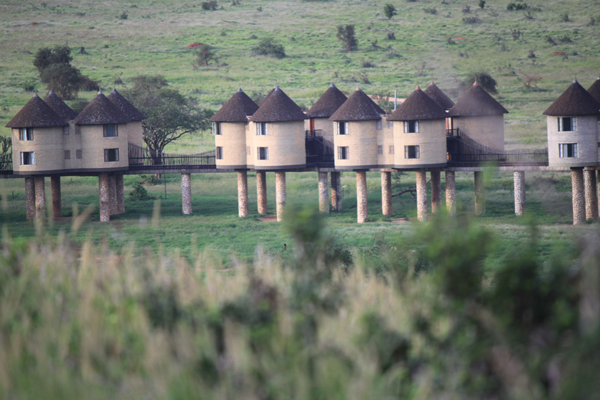
Carole and her daughter Catherine, a future anthropologist, returned from their trip to Kenya totally amazed. They brought back this photo of Sarova Salt Lick Game Lodge where they stayed during their trip to Africa. Do you know who built this unusual hotel? Hilton International—back in 1972!

Built on wood piles, the hotel allows tourists to observe the comings-and-goings of African animals without having to go on safari. The animals come to drink from a source located nearby. No harm is caused to the wildlife because the hotel does not block the natural migration routes.

[caption id="attachment_462" align="aligncenter" width="540"]inusite_avril_2013 Source: Casarazzi[/caption]

[……]

Read more

AD

[caption id="attachment_414" align="alignright" width="360" caption="George Harrison. Photo : Steve Mathieson (Wikipedia)"][/caption]

We’ve often heard of filmmakers and producers who mortgage their homes to complete their oft-dreamed-about movie. Financing is a chronic problem in the art world. But for a musician to mortgage his home to see a movie that an experienced producer declares a big risk? Pretty rare indeed!

Here’s the story.

Perhaps you recognized him.  It’s George Harrison, of the Beatles.[……]

Read more

[caption id="attachment_415" align="alignright" width="383" caption="Source: iStockphoto LP"][/caption]

In one of the older rooms of your house, you may have 12 in. x 12 in. acoustic tiles (pressed cardboard) as a ceiling. These tiles were ultra popular in basements in the 70s.

You’ve decided to cover the ceiling with drywall panels (plasterboard), but your curious nature leads you to ask if the original ceiling would be recoverable.

And you find a tongue and groove plank ceiling. Good news: it’s in good shape.

So what can you do to give it a second life?[……]

Read more

[caption id="attachment_412" align="aligncenter" width="440" caption="Source : DeSerres.ca"][/caption]

On a chilly winter night, you’re enjoying the comfort of your living room to relax and finish reading a novel. But your mind is wandering and you start looking around the room. You realize that it’s been awhile since you changed the decor. A little makeover would perk things up.

However, your budget restrains your creative impulses. That’s okay: wall decals—adhesive wall decorations—can enhance your decor without breaking your piggy bank.

Imagine the entire wall of a living room covered with wallpaper of a sunset. Today, this mural is available in the form of a decal. It’s easier to install than wallpaper, so it’s faster.  What’s not to like?[……]

Read more

The desire to dominate is often reflected in real estate. Think of cathedrals, basilicas, churches built high above valleys, huge castles, the manors of British lords and the luxurious properties of the rich and famous.

Adolf Hitler was certainly not immune to the desire to dominate. We know that painting was one of the German dictator’s passions, but it’s through architecture that he best expressed his need for domination, power and absolute liberty—the very essence of fascism.

Apart from his many headquarters, Hitler built three buildings in Bavaria, on the slopes of the Alps close to the Austrian border, near the city of Salzburg. First there was the Berghof, his second home and favourite refuge, where he entertained foreign dignitaries. Hitler designed the plans himself. Built on the side of a mountain, the home overlooked a scenic valley.

In front of the Berghof was a teahouse, the second of his three buildings. Every afternoon, Hitler took his daily walk and headed to this small structure, where it’s said he liked to relax alone, with friends or with his companion, Eva Braun. Perhaps some of the dictator’s political decisions were made during his daily walks there.

The most spectacular of the three buildings is the Kehlsteinhaus, a cottage designed to serve as a Nazi conference centre. A French diplomat visiting Hitler before World War II was so impressed by the building’s setting that he called it the Eagle’s Nest. The building is located on the side of the Hoher Göll (2500 metres), at the top of a mountain called Kehlstein, whose height is 1,834 metres. When you look at the photo, you feel a slight shiver because you sense that the building conveys Hitler’s ultimate goal: to dominate the world by crushing it under his boots.[……]

Read more

It’s astonishing! There are things difficult to describe with words. What do you think about this ceiling?

[caption id="attachment_387" align="aligncenter" width="512" caption="Barrisol Canada"][/caption]

When you think about basement ceilings, you usually visualize a suspended ceiling. Practical and ingenious, the suspended ceiling gives you access to pipes and electrical wires. For the esthetics however, forget it.

So what are the alternatives? The possibilities are endless. There are tiles that can be transformed according to current styles, with colours, inlays and suspended objects. Shiny copper tiles and fabric tiles with varied shapes and colours caught our attention.[……]

Read more

There’s Ironside (an American TV series), the Iron Lady (Margaret Thatcher), the Iron Curtain, the Iron Gates (a gorge on the Danube). Real estate has now joined the club by offering us “the iron house.”

The “Casa de fierro” is in the middle of the jungle, in the streets of the city of Iquitos, Peru. The walls, ceilings and balcony are made of iron. Other metal alloys were also used.

The long veranda, which stretches along the entire façade, and numerous archways allow for better ventilation of the building, which is subject to the tropical heat. The Ulysses travel guide describes the house as a strange building. Hard to argue with that. The architecture is rather ordinary. It’s the iron that gives the building a special cachet.

Legend has it that the building is the first prefabricated house built in the Americas. How did it end up in the heart of the jungle? And where does it come from? The story is rather outlandish.[……]

Read more